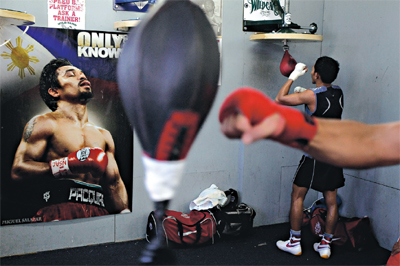
Boxer Manny Pacquiao of the Philippines is reinventing himself as a politician. His poster hangs at the wild card gym Los Angeles
He was a poor Jewish boy from the Bronx who gained immense fame and wealth playing knights, cowboys and Romans. But Bernard Schwartz, who transformed himself into the suave Hollywood star Tony Curtis, was also an archetype of the American century, when nothing loomed larger than the rags-toriches story.
The United States, after all, was the beacon of extreme reinvention. Unfettered by caste or class, an immigrant or a pauper could rise to a penthouse through guile and ambition. Names could be changed, accents altered and pasts erased. And if, as with Jay Gatsby or Joe Kennedy, a few rules were broken along the way, so be it.
Success and the future were all that mattered. Mr. Curtis died in September, but his example lives on. Except that in a century dominated by emerging economies, some of the most epic tales of poverty to plenty are taking place far from Hollywood and New York. Chezi K. Ganesan began life as a member of a despised caste in southern India, the Nadars.
The Nadars were barely above untouchables and could not enter a Hindu temple or stand near a higher-caste person. But Mr. Ganesan has made millions operating VinChip, a high-tech firm based in Chennai. That city has thrived in part through a lessening of caste discrimination, The Times reported, freeing up a wellspring of pent-up ambitions .
“Caste has no impact on life today, Mr. Ganesan told The Times. “It is no longer a barrier.’’ Manny Pacquiao may as well have been an untouchable. Born into a poor, violent slum on the Philippine island of Mindanao, he barely finished grade school. But he found his way into boxing and great success. In 2009, Forbes magazine reported that he earned $40 million.
But partying with Mr. Curtis’s modern?day counterparts in Hollywood was not enough for him. Though Mr. Pacquiao, 31, is fighting on November 13 in Texas, he realized another dream in June when he was sworn in as a congressman in Mindanao, defeating a member of an established political clan. “I want to help people, especially in my province,’’ he told The Times.
“There are a lot of poor people. When I’m old, I want my name, Manny Pacquiao, to be known not only as a good boxer but a good public servant.’’ China has been minting new millionaires and billionaires at a dizzying pace. In October, Forbes magazine reported that China was second only to the United States, with 128 billionaires, up from 79 only one year ago.
It is not unusual for Chinese billionaires to come from humble backgrounds. Wang Chuanfu, chairman of the mobile phone battery maker BYD, for example, was born to poor farmers and orphaned at a young age. But some wealthy Chinese depart from the usual rags-to-riches mythology; they avoid showy opulence.
As the Times reported, “they tend to hide their billions, friends say, sometimes with offshore purchases. Some even boast that they still get a $2 haircut.’’ It’s hard to imagine Mr. Curtis trusting his famous black locks to a $2 barber, even back when haircuts were a lot cheaper.
But then, the understated Chinese billionaires are a far cry from the brazen glamour of the American century, exemplified by Mr. Curtis during Hollywood’s golden age. After he died in September, The Times’s A. O. Scott placed him in the pantheon of other great Hollywood reinventions: “Somewhere in the afterlife, Mr. Schwartz is surely hobnobbing with the likes of Roy Harold Scherer Jr., Norma Jean Baker and Archibald Leach, his peers, co-stars and role models better known as Rock Hudson, Marilyn Monroe and Cary Grant.’’
KEVIN DELANEY