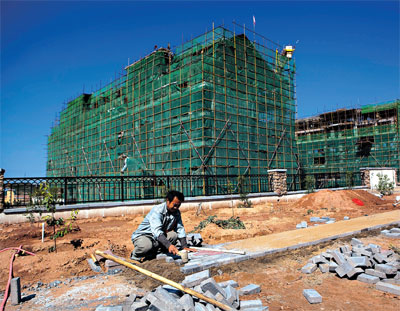
Construction continues in Ordos’s new district. Some fear that China’s speculative investments are creating a real bubble that will burst.
By DAVID BARBOZA
ORDOS, China - By many measures, this resource-rich city in northern China is a fabulous success. It has huge reserves of coal and natural gas, a fast-growing economy and a sizzling hot property market .
There is just one thing largely missing in the city’s extravagant new central district: people. Ordos proper has 1.5 million residents. But the futuristic version of Ordos ? built from scratch on a huge plot of empty land 24 kilometers south of the old city ? is all but deserted.
Broad boulevards are unimpeded by traffic in the new district, called Kangbashi New Area. Office buildings stand vacant. Pedestrians are in short supply. And weeds are beginning to sprout up in luxury villa developments .
“It’s pretty lonely here,” says a woman named Li Li, the marketing manager of an elegant restaurant in Kangbashi’s mostly vacant Lido Hotel. “Most of the people who come to our restaurant are government officials and their guests.
There aren’t any common residents around here.” City leaders, cheered on by aggressive developers, had hoped to turn Ordos into a Chinese version of Dubai - transforming vast plots of the arid, Mongolian steppe into a thriving metropolis.
They even invested over $1 billion in their visionary project. As China’s roaring economy fuels a wild construction boom around the country, critics cite places like Kangbashi as proof of a speculative real estate bubble they warn will eventually pop - sending shock waves through the banking system of a country that for the last two years has been the prime engine of global growth.
On October 19, China surprised analysts by slightly raising a benchmark lending rate, apparently to dampen speculation in the property market. But within China, analysts doubt the small increase in lending rates will slow the incredible building bonanza that is reaching even remote regions like this one. Kangbashi was projected to have 300,000 residents by now. And the government claims that 28,000 people live in the new area.
But during a recent visit, a reporter driving around for hours saw only a handful of residents in the housing developments. Analysts estimate there could be as many as a dozen other Chinese cities just like Ordos, with sprawling ghost town annexes.
In the southern city of Kunming, for example, a nearly 103-square-kilometer area called Chenggong has raised alarms because of similarly deserted roads, high-rises and government offices. And in Tianjin, in the northeast, the city spent lavishly on a huge district festooned with golf courses, hot springs and thousands of villas that are still empty five years after completion.
It might all seem mere nouveau riche folly were it not for China’s goal of moving hundreds of millions of rural residents to big cities over the next decade, in the hope of creating a large middle class. But determining whether the Ordos-style expansion and re-engineering of old cities is being driven by smart planning or propelled by speculative madness is a prime challenge for Beijing policy makers.
Fearing inequality and social unrest, China’s government has struggled to rein in soaring property prices , even as local officials continue to plan new megacities. Patrick Chovanec, who teaches business at Tsinghua University in Beijing, says the building boom is driven by frenzied investors ? not the housing needs of millions of migrating workers.
“People are using real estate as an investment, as a place to store cash ? they treat it like gold,” Professor Chovanec said. “They’re stockpiling empty units. This is going on in cities Bao Beibei contributed research. of virtually every size.”